Entry of
A working glossary of footage and licensing terms
The list kept open in a second window while quotes are read and contracts are signed. Grouped by situation rather than alphabetically, because that is how the words arrive.
Reference11 min read
This is the list kept open in a second window while quotes are read and contracts are signed. Definitions are short on purpose. Terms are grouped by the situation in which they usually appear rather than alphabetically, because that is how they arrive: all at once, in a paragraph you did not expect.
Rights and permissions
- Chain of title
- The documented sequence of ownership and grants that shows the person licensing a work is entitled to do so. Insurers and distributors ask to see it.
- Clearance
- The process of obtaining every permission a shot needs: copyright, releases, music, trademarks, and anything else visible in frame.
- Editorial use only
- A restriction meaning the clip carries no releases and may be used only in news, commentary, education or documentary contexts, never to promote or endorse.
- Exclusivity
- An agreement that the supplier will not license the same material to anyone else, usually limited by industry, territory and time.
- Fair use
- A United States doctrine, set out in section 107 of the Copyright Act, allowing limited unlicensed use. It is judged case by case on four factors, including the purpose of the use and its effect on the market for the original.
- Indemnification
- The supplier's promise to cover the licensee's losses if the license turns out to be defective, normally capped at a stated amount.
- Model release
- Signed consent from a recognisable person allowing commercial use of their appearance.
- Orphan work
- A work still in copyright whose rights holder cannot be identified or found despite a diligent search.
- Property release
- Signed consent from the owner of private property, an artwork or a distinctive object appearing in a shot.
- Public domain
- Material no longer protected by copyright, or never protected. Free of copyright restriction, but not automatically free of release, trademark or publicity issues.
- Rights holder
- The party that actually controls the copyright, as opposed to the party holding a physical copy.
- Sub-license
- Permission to pass part of your granted rights on to another party, such as a co-producer or a foreign distributor. Rarely automatic.
- Warranty
- The supplier's formal statement that it has the right to grant the license. Frequently narrowed or withdrawn on archive material.
Licenses and money
- All media
- A grant covering every distribution channel, current and often future. The widest media line, and the one that moves a quote the most.
- Broadcast license
- A grant for transmission on television, usually specified by territory, number of runs and window.
- Comp
- A low resolution, watermarked copy supplied for offline editing and internal approval before a license is bought.
- Extended license
- An upgrade to a standard royalty free license, typically needed for broadcast, very large audiences, resale items or multiple users.
- In perpetuity
- A term with no end date. It does not mean unlimited: media, territory and exclusivity still apply.
- Research fee
- A charge for a researcher's time spent finding material, sometimes credited against a later license.
- Rights managed
- A model in which the fee is calculated from the declared use. Change the use and a new license is required.
- Royalty free
- A model in which one fee buys repeated use within stated limits, with no further payment per use. Neither free nor unlimited.
- Subscription license
- A model in which a recurring fee allows downloads under a standing license, which usually ends, for new downloads, when the subscription does.
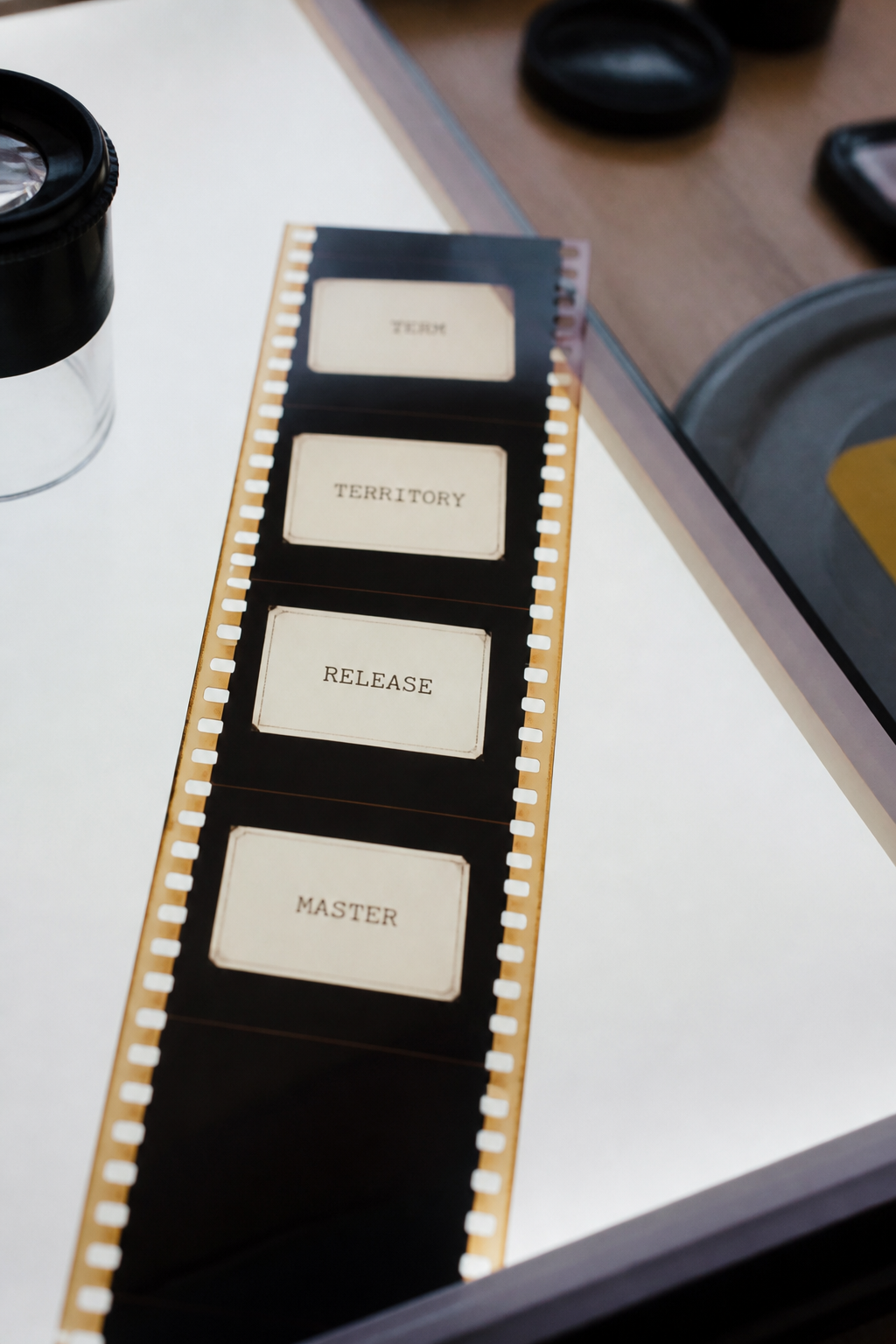
- Term
- The length of the permission.
- Territory
- The geographic area in which the finished piece may be shown.
Technical and delivery
- Aspect ratio
- The shape of the frame. Archive material is frequently 4:3, which must be pillarboxed, cropped or deliberately framed inside a 16:9 timeline.
- Codec
- The compression scheme of the delivered file. Editing codecs such as ProRes and DNxHR behave very differently in a timeline from delivery codecs such as H.264.
- Drop frame
- A timecode counting method used at 29.97 frames per second so that timecode stays aligned with clock time. It skips numbers, never pictures.
- Frame rate
- Frames per second. Common values are 23.976, 24, 25, 29.97, 50 and 59.94. Mixing them without conversion produces stutter.
- Handles
- Extra frames supplied before and after the requested section, so the shot can be trimmed and dissolved. Ask whether they are included.
- Interlaced
- A legacy scanning method in which each frame is split into two fields. Older broadcast and archive material is often interlaced and needs deinterlacing.
- Log profile
- A flat capture curve preserving highlight and shadow detail for grading. Log clips look washed out until they are graded.
- Master
- The highest quality copy held by the supplier, from which deliverables are made.
- Pull-down
- The pattern used to fit 24 frames per second material into a 29.97 signal. Undoing it badly leaves combed frames.
- Telecine
- The transfer of film to video. Two telecines of the same reel, done years apart, can look like different material.
- Timecode
- The frame address of a clip, written hours, minutes, seconds and frames. The only reliable way to specify a section of a long archive reel.
- Upscale
- Enlarging lower resolution material to a higher delivery format. It adds pixels, never detail.
- Watermark or burn-in
- Visible marking on a preview copy, often combined with visible timecode so that a specific frame can be quoted back to the supplier.
Craft and workflow
- Asset identifier
- The supplier's own reference for a clip. Quote it in every message; titles and thumbnails are ambiguous, identifiers are not.
- B-roll
- Supporting footage cut over or between the main material, used to cover edits, establish place and show what a speaker is describing.
- Bin or lightbox
- A saved collection inside a library's interface. The fastest way to hand a shortlist to a director without losing the identifiers.
- Edit decision list
- A machine readable list of the clips and timecodes used in a cut. It is also the fastest route to an accurate clearance list.
- Establishing shot
- A wide shot that tells the viewer where the next sequence takes place.
- Insert
- A tight shot of a detail, cut in to carry information or to hide a join.
- Locked-off shot
- A shot from a fixed camera with no movement, useful under titles and for time comparisons of the same place.
- Shot list
- The written list of shots a sequence needs, ideally with the license scope written next to each line.
- Slate
- The board filmed at the head of a take, carrying production, scene and take information. In archive collections the slate is often the only surviving metadata.
- Stock footage
- Pre-existing footage licensed for use in another production, whether shot last month or a century ago.
Using this list
Two of these terms cause more trouble than the rest combined. "Royalty free" is read as "free", and "editorial use only" is read as "for serious films". Both readings are wrong, and both are unpicked in the comparison of royalty free and rights managed licensing. If you are about to write to an archive, the nine lines a footage research request needs uses this vocabulary in the order a researcher expects it.
Corrections to this entry
- : added handles, pull-down and drop frame after a delivery argument that turned on all three.