Entry of
Types of b-roll shot, and what each one does in the cut
Most b-roll falls into a handful of recognisable kinds, and each kind solves a different problem in the edit. Knowing which one is missing turns a vague request for "some b-roll" into a search that comes back with usable shots.
CraftProduction12 min read
B-roll is the supporting footage intercut with the main material of a film or video, the A-roll, which is usually an interview, a presenter or the scene itself. This log sorts it into eight working types: establishing shots, cutaways, inserts, noddies and reaction shots, process shots, atmosphere shots, archive and stills, and a last group of late arrivals made up of pickups, re-enactments and stock clips. Each type answers a different question the viewer would otherwise be left asking.
The list matters because an edit is rarely short of b-roll in general. It is short in one particular way. A sequence with plenty of wide views and no detail feels distant; one with plenty of detail and no wide views leaves the audience unsure where they are. Naming the type that is missing is the quickest way to brief a camera operator, a researcher or a library search.
What counts as b-roll, and what is the A-roll it sits under?
The A-roll carries the story: the sentence being spoken, the action the scene exists to show. B-roll is everything cut over it or between it to make that story readable. The distinction is one of function, not of camera or quality. A fine aerial view is b-roll in a documentary interview and the main event in a travel film.
The two names are older than video. In 16mm film finishing, shots were alternated between an A roll and a B roll, with black leader opposite each one, so that the splices stayed invisible in the print. Television news kept the labels. Until the mid-1970s news crews shot on 16mm, and a telecine set up with one projector per roll let the sound roll play while silent pictures from the second roll were cut in over it. Linear video editing in the 1980s carried the habit onto tape, with an A deck for the main material and a B deck for the supporting shots. The history of the A and B rolls is well documented; this entry is about the shots themselves, and what b-roll does once it is in the edit is covered job by job in an earlier entry.
Establishing shots: where are we, and when?
An establishing shot sets up the context for the sequence that follows. It is usually a long or very long view at the start of a scene: a skyline, the outside of a building, a room seen from its far corner. The opening view of the Brooklyn Bridge in Saturday Night Fever is the textbook case of a landmark doing the work of a caption.
Establishing shots also carry time. An exterior of a building at night followed by an interior tells the viewer that the conversation is happening at night, inside that building, even when the interior was filmed somewhere else entirely. That is why productions license them so often. A city at dusk, in the right season, is cheaper to buy than to wait for.
Cutaways and inserts: what is the difference?
The two words are used loosely, and many libraries file them together. The cleaner distinction is about what the shot covers. An insert reframes action that is already happening in the main shot: the letter the character is reading, the hand on the dial, the sign over the door. A cutaway leaves the main action for something it does not contain: the crowd outside, the street the speaker grew up on, the machine she is describing.
Inserts are the shots the eye needs to read a detail. It's a Wonderful Life (1946) uses inserts of a sign and a record player to make small actions legible. They are often filmed separately, by a second unit with stand-ins, because nobody needs the lead actor's face to film a hand. Cutaways do a different job: they let the editor remove part of a shot without the join showing, and they set the pace of a sequence by stepping away and coming back.
Noddies and reaction shots in an interview edit
An interview filmed with one camera has a built-in problem: every cut in the answer shows. The traditional fix is the noddy, a shot of the interviewer listening and reacting, usually filmed once the interview itself is over. Interviewers often repeat their questions on camera at the same session, so that the editor can shorten an exchange without inventing one.
Reaction shots of an audience, a relative or a colleague do the same work in observational films. The rule is honesty. A reaction lifted from a different moment changes what the scene says, and a careful editor keeps it inside the same conversation.
Process shots: showing what the speaker describes
When someone explains how a thing is made, repaired or measured, the audience wants to watch it happen. Process shots are the run of medium shots and close details that follow a task from start to finish: the dough folded, the weld drawn along a seam, the sample dropped into a tray. They are the most useful b-roll in an explanatory film and the hardest to buy, because they belong to one process in one place.
Film them as coverage: a wide, a medium and a detail of each step, each held long enough to trim at both ends. A process filmed only in close-up cannot be followed; one filmed only wide hides what is going on.
Atmosphere and texture: timelapse, aerials and weather
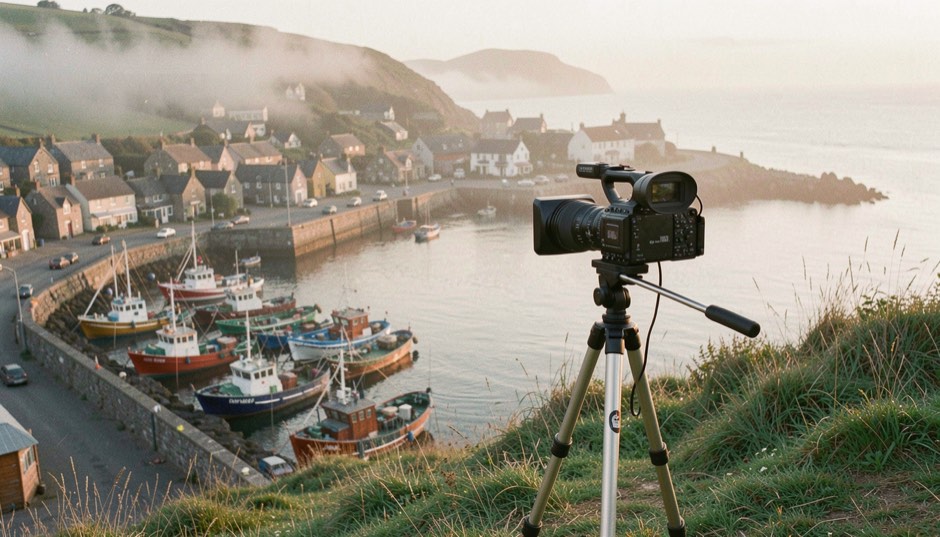
Some b-roll exists to set a mood or mark the passing of time rather than to carry information. Timelapse squeezes hours into seconds, slow motion stretches a moment, aerial views give scale, and weather, light on water, traffic at night or an empty corridor all carry tone. This is the family most often licensed, since a sunrise over a coastline belongs to no particular story, and it is also the family most often overused. A sequence built only from atmosphere stops telling the viewer anything.
Archive, stills and the slow move across a photograph
Historical subjects depend on b-roll somebody else filmed: newsreel, home movies, government films, old broadcasts. Where no moving image exists, still photographs and documents stand in for it, brought to life with a slow pan or zoom. The move was traditionally made on a rostrum camera, and the National Film Board of Canada's City of Gold (1957), built from archival photographs of the Klondike gold rush, is an early example that Ken Burns himself has cited. The technique now carries his name, and editing software such as iMovie and Final Cut Pro offers it under that label.
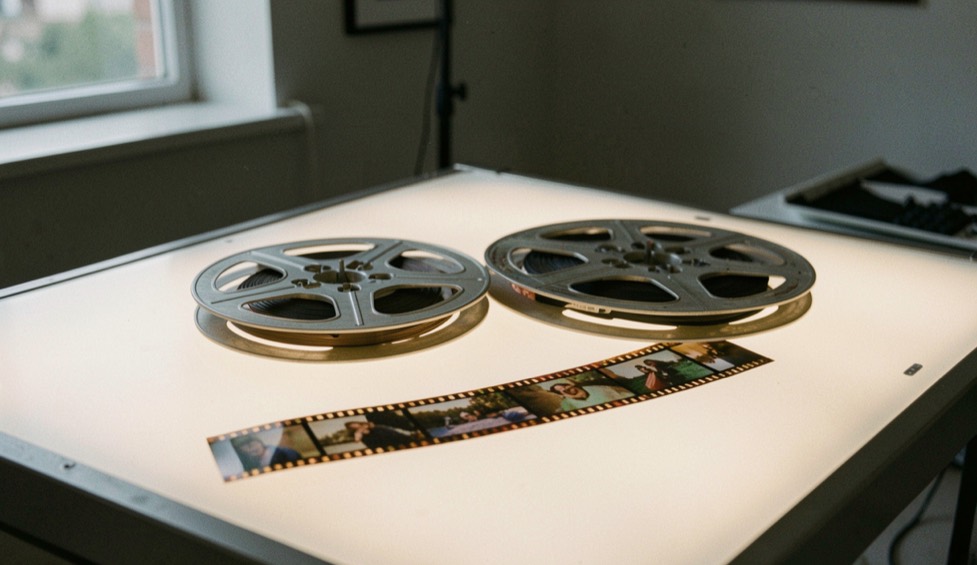
Archive b-roll comes with conditions the other types do not carry: the frame rate and shape of the original picture, the chain of rights behind the copy, and the plain question of whether the holder can license it at all. Knowing where archival and newsreel footage is held is the first step. Reading the item record before falling for a shot is the second.
Pickups, re-enactments and stock: the b-roll nobody planned
The last group covers shots that arrive late. A pickup is a small shot filmed after the main shoot to fill a gap the edit has exposed, a missing insert or a cleaner exterior; it is not a reshoot, which redoes whole scenes. In docudrama, staged re-enactments are cut in as b-roll over testimony, and they need to read as staged. Stock footage closes whatever gap remains, which is why so much of it is generic by design.
| Type | What it shows | Example | Usually |
|---|---|---|---|
| Establishing shot | Place and time of the next sequence | A skyline at dusk before an interior scene | Licensed or filmed |
| Cutaway | Something outside the main action | The street a speaker is describing | Filmed |
| Insert | A detail inside the main action | A hand turning a key, a letter being read | Filmed |
| Noddy or reaction | A listener's response | The interviewer nodding, filmed after the answer | Filmed |
| Process shot | A task, step by step | Dough folded, a weld drawn along a seam | Filmed |
| Atmosphere | Mood, scale, passing time | A timelapse of clouds, an aerial of a coastline | Licensed |
| Archive and stills | The past | Newsreel, a photograph panned on a rostrum | Licensed |
| Pickup or stock | A gap found in the edit | A cleaner exterior filmed or bought late | Either |
Which types are worth licensing rather than shooting?
The split follows a simple line. Anything specific to your subject, the person, the workshop, the process, the street, is filmed, because no library holds it. Anything generic, historical or expensive to reach is licensed: the establishing view of a distant city, the weather, the aerial, the past. Cutaways sit in between and are decided one at a time. Working through the shot list type by type, rather than as one block labelled b-roll, is what keeps the budget honest, and the full cost comparison between licensing and shooting sets both columns out.
Clearance follows the same list. Establishing shots and atmosphere often contain recognisable people, shop signs and vehicles, which matters a great deal in advertising and much less in editorial work. Archive brings its own chain of rights. Shots you filmed yourself still need releases from anyone identifiable in them.
Three questions readers ask about b-roll
Is b-roll capitalised?
Reference sources, Wikipedia's entry among them, write it B-roll, with a capital B and a hyphen, and list B roll and B-reel as variants. Lower case b-roll is common in running text and is the form this log uses. Whichever form you choose, keep it consistent and keep the hyphen.
Is b-roll the same as stock footage?
No. Stock footage is one source of b-roll, not another name for it. Most b-roll in a documentary is filmed by the production itself; stock and archive fill the shots that cannot be filmed, either because they happened in the past or because the trip would cost more than the licence.
Is b-roll filmed before or after the interview?
Both, but in news and documentary work much of it is filmed after the main interview, once the crew knows what the speaker talked about. Noddies are normally filmed afterwards. A reliable habit is a first pass of the location before the interview and a targeted pass after it.